Wednesday, December 21, 2022

Translation - Cyril Neyrat on 'Trois jours en Grèce' (1991)


Still from Trois jours en Grèce, 1991 

As usual at this time of year, I find myself with a little downtime and in a charitable mood. In the spirit of the season, I offer a translation of Cyril Neyrat's terrific essay on Jean-Daniel Pollet's 'Trois jours en Grèce,' originally commissioned for Les éditions de l'oeil's 2020 DVD release of the film. I began the translation back in 2020, in the hopes of putting it online along with subtitles of Pollet's film. Now that fansubs have finally appeared, here is the text which will hopefully (almost certainly) illuminate its many layers and themes, as well as its place in Pollet's filmography.

P.S. You can download the film with English subs here. Many thanks to the hard working subtitlers who shall remain nameless.


In Greece, Blessed, On A Magic Carpet
by Cyril Neyrat


“He looks in the mirror to reproduce his death accurately.”
Yannis Ritsos


Jean-Daniel Pollet called Greece his “second homeland.” He first went there in 1962, at twenty-six years old, on the trip that led to his film Méditerranée. Upon his return, he spent several months locked in a cellar, assembling a cut that he finished “one Easter Sunday.” The result, something never before seen: a series of recurring images that form a fugue, whose loops retrace the author’s circular voyage on the Middle Sea. Over the years, Pollet never stopped returning to Greece, where he set and shot a number of his major films: Bassae, Le Soleil et l’Ombre, Tu imagines Robinson, L’Ordre. In 1991, Trois jours en Grèce concluded the series and the filming; three decades after his first trip, it was his last visit to his native land. Faithful to the profound principles of Pollet’s cinema, the final Greek film is a return to the origin: a remake, reprise and relaunch of Méditerranée. A reinvention of its fractured circularity, its syncopated allure, the same vertiginous dance over the abyss, but slackened, spread out, lightened or lifted by the grace of newfound serenity.


Yet, it is a film that, along with its author, returns from far, far away.

    1988: invited to participate in a symposium on the Gulf of Corinth, Pollet seizes the opportunity, abandons the symposium, and spends three days alone in and around the small coastal town of Itea, filming with his camcorder.


    April 14, 1989: Pollet tests emulsions by filming the train rails that pass below his property. He shoots at ground level, waits for the train to pass, hears the horn, but does not have time to step aside. The locomotive hits him (“I bounced on the second and third cars before falling back to the tracks”) and leaves him for dead (“Twenty-five fractures, seven of which were open”). He begins a long stay in hospital, a very long convalescence, a bedridden interlude of almost one year. From this prolonged absence, the work to come is born. It is in the hospital that Pollet imagines the film that will become Trois jours en Grèce, based on the 1988 trip and the two hours of footage brought back from Itea. It is in that room that he writes and composes L’Entre Vues with Gérard Leblanc, an exhaustive book that, before reviewing his life and past work and sketching the films to come, opens with a long account of the accident.


    Autumn 1990: out of hospital, Pollet finishes preparations for Trois jours en Grèce and travels to Greece to shoot. Two months circling the Golf of Corinth, as he had the Méditerranée twenty-nine years prior.


    Early 1991: editing of Trois jours en Grèce. On January 17, “Operation Desert Storm” begins, launching the Gulf War. With the help of Leblanc, Pollet incorporates a series of images of the war taken from French television into his film.


Trois jours en Grèce is therefore the film of a revenant, of a man who has returned from the dead. Of a death-seer.


    In the account of the accident that opens L’Entre Vues, Pollet recounts the horror of his first days in the hospital, the panicked sensation of dying and the jubilation of coming back to life, like a second birth. He would add sometime after: “For two years, I felt blessed.” Two years, that is to say, the interval between the train accident and the end of editing of Trois jours en Grèce: an enchanted intermission from life, a grace granted, a double-miracle of a survival, and a survivor film.


    This miraculous progression from the accident to the film, the disturbing intimacy of the author’s catastrophe and his cinematic achievement, were experienced by Pollet in full consciousness.

On the accident:

“I shot up in the air and saw what a camera would capture if we threw it in the air… Cries from Françoise and my son. I was flying. I think I waited a little while before coming back down. I felt disjointed. I fell, conscious. I never lost consciousness. I lay there. I could hear the sound of the train receding. I said to myself “It’s done.” … Then, they arrived. Morphine and stretcher. “Here! What a beautiful tracking shot. Here, the weather is nice tonight.” Traveling indeed, the blue of the sky.”

On filming:

“At this point, I’m on a magic carpet for two months. With the best technical team that I’ve ever had. And then Greece, of course, which completely carried me. It’s a film that was shot without notorious incident, neither physical nor mental, nothing. Of all my films, it is the one where the shooting was the clearest.”

    Pollet remembers the film as an extension of the accident, as if, suspended in the air after the impact, he had not fallen but had embarked on a flying carpet to tour the Gulf of Corinth. “I think I waited a little while before coming back down.”: two seconds of suspense stretched into two years of life, which ended with two months of filming.


Like L’Entre Vues, Trois jours en Grèce begins with an evocation of the accident. Like the book, the film seems to find its origin, its point of departure, and its basis in the experience of the shock, the suspense and the fall (and in syncope [i] as an approximation of death). This evocation - made up of fixed shots of the tracks, miraculously retrieved after the accident, much like their photographer – follows the first in a series of long sinuous tracking shots and images of boats, a rather unique manifestation of world apprehension from the death-seer. The explorative Steadicam shots of the filmmaker’s home return at the end of the journey, altered by a few variations, as if the entire film takes place in this unstable interval. This temporal vertigo is clearly perceived and articulated by Suzanne Liandrat-Guigues and Jean-Louis Leutrat:

“The clock in the filmmaker’s home, which is seen at both ends of the film, is only shown to have advanced a few minutes from the beginning to the end. The film starts with images captured just before the accident suffered by the director; it ends with the launch of the Ariane at Kourou [ii], which occurred within a few days (a few minutes) of the accident. It’s as if these “three days in Greece” were flashing before the filmmaker’s eyes at the instant of the collision.”


    Movement is strange: a sort of floating crawl, unassignable to any human or animal perspective or presence, simultaneously penetrating the visible while remaining detached from sensorial reality. It seems to come from the accident itself, springing forth in the wake of the departing train that left the author for dead along the tracks. Is this the return to the world and life after syncope? But it is not the movement of a presence: rather, it’s that of a spirit, the flight of a ghost, or the inner movement of a dreaming, imagining soul. As if the traveling subject of Trois jours en Grèce had never left his hospital bed, or even the space above the tracks. Two seconds, two minutes: the film freezes time in the suspense of the impact. “Three days in limbo, until the resurrection,” wrote Péguy [iii].


    The initial exploration of the house is interrupted by a shot of Pollet’s hands cutting out photos of Greek vases, this after he discards a stack of magazines whose covers feature images of the Gulf War. The voice of Jean Thibaudeau, a friend and author who penned the voiceover, comments in a hushed tone: “He prepares his film. In the end, we do not have to know what comes before or after, if the trip is taking place, has taken place or will take place, or not.” These two perfectly contradictory sentences provide the key to Trois jours en Grèce and its enigma. The first indicates the traditional essay film, in the category of “travelogue”: we see the filmmaker at work, we prepare to follow the making of a film about a trip to Greece. The second belies this assertion by stating on the one hand that there will be no chronology (what we will see will belong neither to the past, nor to the present or the future), that all temporal reference will be erased along with any concept of duration (three days, two years, a few minutes?), while on the other hand, questioning the reality of the trip itself. What Thibaudeau suggests, decisively, is that the experience in question does not follow the order of life lived; on the contrary, it follows its negation.


    The sequences of the film that immediately follow confirm this, mixing temporalities to the point of dissolving them, producing a temporal vertigo that opens up an abyss of thought. From the following shot on, we are in Greece, but filmed as purely interior, imaginary movement: aerial tracking shots, non-human vision following the scheme initiated in the exploratory scenes of the house. Pollet’s voice recalls the first trip, that of 1988, a camcorder in hand. “Two years later,” he says, “the circumstances being favorable, I settled in my office.” In the meantime, there was the accident: the second trip, which bore Trois jours en Grèce, was of a completely different nature: a motionless vertigo, suspended between a hospital room, a home office and the editing table. For it is above all (and again, as in Méditerranée and Contretemps) the editing that produces the vision from beyond the grave, that recalls another trip: to the land of the dead.


    And it is vertigo. Vertigo from the back and forth trips from here to there – the repeated departure of the plane, denied as a reality lived, become vision. Intoxicating vertigo, Dionysian Steadicam tracking shots winding, swaying, crawling “under the delirious whip of God” – a chorus of Bacchae from Euripides, recited by Olimpia Carlisi in the streets of Itea. Still dizzy from the tracking shots punctuated by photographs – time seized, stuttering, permanent mishaps that ruin its passage with the irregular repetition of breaks. The poetry of Trois jours en Grèce rekindles that of Méditerranée, in the sense that it articulates and unites the two dimensions of syncope [i], medical and musical: as fainting and returning, and as caesura, counter-rhythmic interruption. The syncopated rhythm, the breaks that never cease to disturb the flow, that suspend movement to resume it elsewhere and otherwise, are like an echo of the accident, the original syncope, extended and repeated in the narrative, an undulating propagation of the collision and the absence that birthed the film.


    In the end, the filmmaker’s inner journey brings him back to where he came from. But from where has he come? From his home, from the Favet farmhouse (filmed like an island), from Ithaca or the Island of the Dead? [iv] From his own death, the other side? It is only at the close of the journey, just before the experience of the return trip, in the extraordinary nocturnal, subterranean sequence at the Omonia station of the Athens metro, that the voice of Thibaudeau explicitly makes the association with Ulysses’s nekyia [v], his descent into the underworld in Book 11 of the Odyssey. Just before, Pollet pays homage to Yannis Ritsos, the great, universally admired poet. Modern Homer, cantor of the sufferings and dreams of the Greek people in the 20th century, he died during the filming of Trois jours en Grèce. Pollet invokes him through the editing, reciting phrases from Monochords, their timeless brilliance a perfect antidote for the ugliness and stupidity of the televised images of the war. In return, like Virgil with Dante, Ritsos leads Pollet into the underworld of Omonia, to meet the dead. The war of the Persian Gulf is a rather sad remake of that of Troy, and Pollet does not pretend to measure Trois jours en Grèce against the Odyssey. But he does remember it, remembers that the journey, unlike war, is without a map or calendar, and that a return is possible. Omonia, like all the other places visited by Pollet in Trois jours en Grèce, belongs to the world of the living, but is seen through death, made strange by the vision of he who does not return, shaken yet liberated, from the dead.


Méditerranée, Bassae, L’Ordre, Trois jours en Grèce, Dieu sait quoi: Pollet’s great essay films are profoundly molded by the paradoxical counter-movement of their absent subject, who has left the society of the living only to return as pure perception, wholly receptive to its immemorial appearance. Such an experience – the poetic experience itself – is not dark, but luminous. It is a joy, a jubilation, the feeling of lightness described by Montaigne and Rousseau when they recounted their return to the world after their respective accidents with horse and dog [vi]. The shock of the syncope, which plunged the subject into the abyss of his past and future death, is also the root of the interior movement of the lying being, of the eternal convalescent who lets himself be carried, floated, rocked by the waves of thought and emotion.


Trois jours en Grèce is a miraculous film, primarily because it is the work of a man who has returned from his own death, and recalls the void. Pollet’s cinema comes to us from this non-place, imagines its expanse, invents its exploration. Like Méditerranée, Trois jours en Grèce is not a travel film in the sense that it relates the experience as lived by the filmmaker in Greece. The work of the cinema in Trois jours en Grèce is that of the syncope: it consists of the negation of the lived, which opens up a poetic existence as a sort of altered life, outside of oneself, outside of time, suspended in a pure haze of memory. The poet’s journey is internal, and still. If Pollet winks at Nerval by titling a chapter of L’Entre Vues, “I am the other,” it is because he too had “twice crossed the Acheron victorious.” Like the author of Les Chimères, he returned from his round trip to hell an even greater poet. [vii] Like Méditerranée, Trois jours en Grèce is, in every sense of the word, a chimera film.


[i] Syncope, origin Greek, has two meanings in this essay; the medical term for losing consciousness, and syncopation, the musical term for a disturbance in an established rhythm.

[ii] The Ariane was a series of rockets that were regularly launched from the Guiana Space Centre in Kourou, French Guiana through the summer of 1989, the year of Pollet’s accident. The name of the model refers, of course, to Princess Ariadne of Greek mythology.

[iii] A quote from Charles Péguy’s dramatic poem, Le Mystère de la charité de Jeanne d’Arc (1910).

[iv] L’Île des Morts, a small French island in the Bay of Roscanvel.

[v] An ancient Greek rite used to summon and question ghosts of the departed.

[vi] Circa 1570, French philosopher Michel de Montaigne fell from a horse and lost consciousness for several hours, an event he recounted in his Essais. In 1776, writer Jean-Jacques Rousseau suffered a concussion when he was run over by a Great Dane in the streets of Paris, an episode immortalized in his Rêveries du Promeneur Solitaire.

[vii] Je suis l'autre is the title of the poet Gérard de Nerval’s autobiography. In Nerval’s poem, El Desdichado (included in his collection, Les Chimères), the narrator claims to have crossed the Acheron, one of the five rivers to the Greek underworld, and returned.

Sunday, May 9, 2021

Video - OubaelPhoumet Tribute


Yesterday, lazing about on a Saturday, I created a Youtube channel. I had considered doing so for some time, to post movie clips and tunes for personal sharing. However, my first video is a touch more special than the selection of the day; it's a tribute to the mighty OubaelPhoumet. A mysterious uploader from France (who seems to have disappeared from social media, and hasn't posted anything on Youtube in six years), he is known to the initiated for his tastefully curated videos of jazz (and other styles) paired with clips from art films of the 60's, 70's and beyond. His channel was absolutely crucial to me in my early days of cinephilia/jazz connoisseurship, and upon revisiting it recently, I'm glad to say that his selections and sensibilities are as fresh now as they were then.

My very modest homage features a moody cut from drummer James Zitro that I hope would please the man of the hour. As for the film clip, it shouldn't be too hard to guess where it's from. If you like it, then don't hesitate to seek out the real thing at the link below.


Monday, April 5, 2021

Translation - Embrace of the Souls (2020)

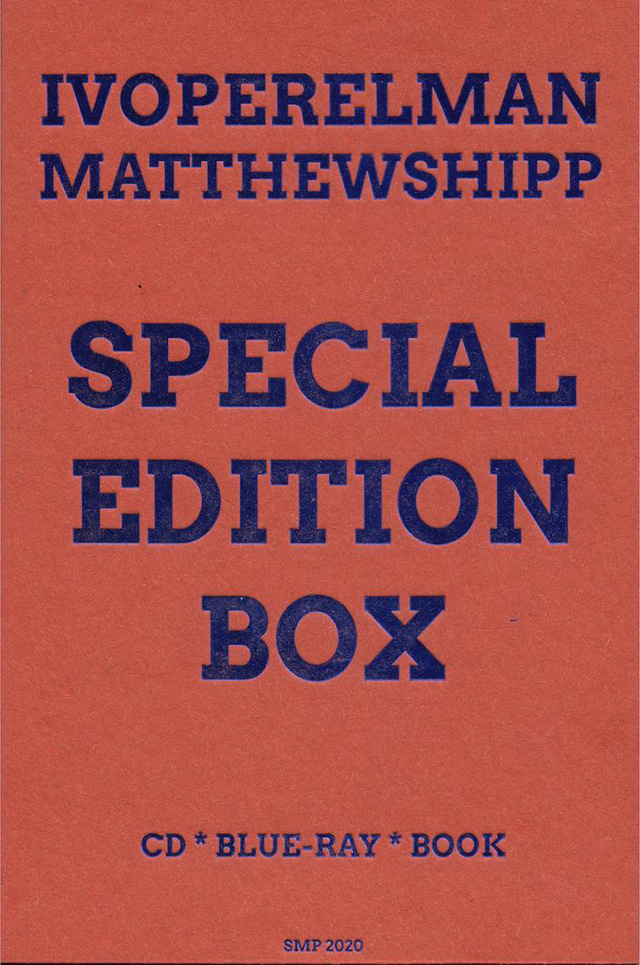
A quick note, not surprisingly about a translation: SMP Records, the imprint of German improvising pianist Hannes Selig, has just issued a bountiful box set dedicated to the longtime saxophone/piano duo of Ivo Perelman and Matthew Shipp. Special Edition Box, as it is called, gathers an unreleased 2019 studio session by the pair, a concert film of their performance in São Paulo from later in the same year (in multiple formats), and a lengthy essay by Belgian writer/ musician/ sometimes-impresario Jean-Michel Van Schouwburg, titled 'Embrace of the Souls.' Last summer, while the global pandemic raged, I had the pleasure of translating this long text from the French over the course of two weeks. It is easily the most gratifying translation work I've done, and the result is much more than extended liner notes. Jean-Michel's essay captures the essence of one of the most accomplished ongoing collaborations in improvised music/jazz, and does so with a sensitivity and generosity perfectly suited to his subjects. I hope one day to be able to share the entirety of Jean-Michel's piece, here or somewhere else. In the meantime, the SMP box is available in limited quantities.

For French-reading fans of free improvised music, I recommend a visit to Jean-Michel Van Schouwburg's fantastic blog. His love of music, sounds, of pure creative expression, overflows in practically every post.

Wednesday, March 3, 2021

Translation - Jean-Marie Buchet on 'Hatari!' (1963)

Still from Hatari!, 1962 

Surprise! Quite generously, my friends at the Belgian film site Sabzian have agreed to publish a new translation of mine, a full-length review of Howard Hawks' ensemble adventurer, 'Hatari!' Written one year after the film's American release by Belgian writer/filmmaker Jean-Marie Buchet, it is a neat introduction to a great and under-recognized cinematic mind (Buchet's), as well as a reminder of the large-scale greatness of Hawks' film. For those keeping track, this translation is actually my first published anywhere on the web other than this blog.

If your interest in Jean-Marie Buchet's films is piqued, I highly suggest his first feature 'La fugue de Suzanne' (1974), a droll, absurdist comedy that plays like Luc Moullet crossed with Jean Eustache. It is available on demand from Avila, another wonderful resource for Belgian cinema.

Anyway, enjoy the piece, and by all means, take the opportunity to rewatch 'Hatari!'

** Jean Marie Buchet on 'Hatari!' (1963) **

Wednesday, June 17, 2020

Translation - Chris Marker (The Impossible Book) (2016)


Maroussia Vossen (left) & Djaleng from Paleodia (right)
Still from Pattes de deux, 2010 (Vimeo)

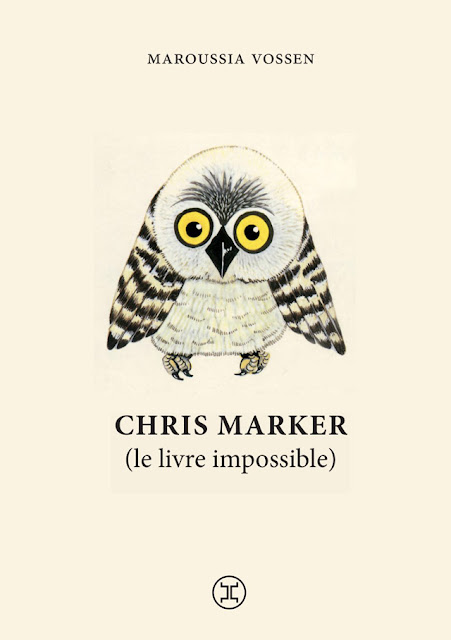
For my latest (seemingly) random act of translation, I humbly present you with my 2020 quarantine project: an English translation of Maroussia Vossen's lovely memoir Chris Marker (The Impossible Book). Marker is, of course, the enigmatic filmmaker and media polymath best known for his twin masterworks, La Jetée (1962) and Sans Soleil (1983). Vossen (pictured above), a dancer and choreographer, is his adopted daughter. This slim edition from 2016, published by Éditions Le Tripode, is an unprecedentedly intimate look at the relationship the two shared from her birth to his death.

The French language book, which I greatly enjoyed reading and translating, can and should be purchased here. A first-time author, Vossen proves to be a deft guide to Marker's idiosyncratic world. More than a catalogue of obscure factoids (what he ate for breakfast every day, what his family life was like) or an inside look at his films (which she consciously avoids considering at length), hers is a personal story built from rich, diffuse connections, the same sorts of connections Marker illuminated across his varied body of work.

French speakers can watch an interview with Ms. Vossen here in which she discusses the book. English readers can click the cover image below to download a PDF of my translation. It was made in a piecemeal fashion in between work and parental duties, and, due to my excitement to post it, only edited lightly. Feedback is certainly welcome, but please be kind!

More importantly, enjoy!


Tuesday, March 17, 2020

Translation - Letters to François Truffaut (1959 - 1971)


La Napoule, 1959 (source)
François Truffaut at bottom left, Jean-Daniel Pollet third from left in third row from bottom (with draped sweater)

Having found myself with some additional free time (for reasons obvious to anyone reading this at the time of publication), I've decided to try my hand at a straight-ahead French translation, a first. The piece I chose is from the March 2020 edition of the great Trafic film journal, three letters from the vastly underrated filmmaker Jean-Daniel Pollet to his mentor at-times, François Truffaut. The two interlocutors, who connected in the late 1950's at the time of their initial successes, present an odd pair; the dynamic Truffaut, an admired critic and cinematic wunderkind who became one of the most commercially-viable filmmakers of his generation, and Pollet, a little-known New Wave outlier best known for stern, poetic works that evoked Resnais and captivated Godard. Still, there is some stylistic overlap. Pollet's more conventional comedic efforts, which he alternated with his more abstract works, approached the feel-good tone of Truffaut's most popular films. Pollet's fondness for one particular actor (Claude Melki) as his on-screen alter ego also recalls Truffaut's symbiosis with Jean-Pierre Leaud. In addition to any similarities, it seems the two shared, at some point at least, some degree of mutual professional respect.

Along with the letters, I've translated a short forward by filmmaker and writer Jean-Daniel Fargier, a long-time friend and collaborator of Pollet's. Sadly, the retrospective of Jean-Daniel Pollet's films set for March 2020 at the Cinémathèque Française (which certainly spurred the publication of these letters) has been postponed due to the unforeseen international emergency. Luckily, as a sort of consolation, Les Éditions de l’Œil has recently issued eight of Pollet's newly-restored films on DVD with accompanying booklets, as well as a sorely needed biography of the relatively mysterious director by Fargier. Each and every one of these editions is highly recommended.

Issue 113 of Trafic can be purchased here. I would certainly urge all French-reading cinephiles to subscribe. With the unfortunate recent demise of Cahiers du Cinéma, Trafic is literally peerless among film journals.

Enjoy!


Letters to François Truffaut
by Jean-Daniel Pollet

Truffaut saved everything, scripts, correspondences, photos taken on set. His archives contain many treasures that find their way, little by little, to various publications. Pollet threw away (almost) everything. A pity. We will never know exactly how the young director of The 400 Blows responded to a request from the very young director of As Long as You Get Drunk… [i] to have a look at the script for his first feature film. Nevertheless, we get an idea by reading between the lines of Jean-Daniel Pollet’s response to the comments by his famous elder.

        What is striking in this exchange is the strong sense of complicity, founded on mutual esteem. Truffaut had just won at Cannes with his first feature, and had written a few months earlier in Arts, after seeing the premiere of his “little brother’s” [ii] first short film crowned with a Golden Lion at Venice, a magnificent review that compared its author to Jean Vigo, before making this prediction: “At 21 years old, Jean-Daniel Pollet displays a sensitivity and a vitality that make him one of the four or five best emerging French filmmakers.” We can read this on page 467 of the collection Chroniques d'«Arts-Spectacles» 1954-1958, compiled by Bernard Bastide for Éditions Gallimard. [iii]

       It is also thanks to Bernard Bastide that are able to publish these letters from Pollet to Truffaut. He generously shared his discoveries with us, made while perusing Truffaut’s papers at the Cinémathèque Française with the intention of assembling a collection of his favorite filmmaker’s correspondences with writers. Thanks to our comrade from Nîmes!

       We are also very grateful to Laura Truffaut, who manages her father’s estate in concert with her two sisters, Eva and Joséphine, for authorizing this publication.

Jean-Paul Fargier


1.
First contact after Cannes, and the success of The 400 Blows
(No date, likely May 1959)

I hardly know you, but I take great pleasure in the news of the success of your film, which makes me wish for you, as if it were for myself, the best at Cannes. The unanimous praise that I hear from all sides for The 400 Blows, from people incapable of false praise or snobbery, increases my desire to see your film… which, as it is, you certainly don’t like, but don’t cut too much of it, so there’s some left for the street (?).

Jean-Daniel Pollet


2.
Reply to Truffaut’s response to his script for The Bastion (Le Bastion) (which would be made as Line of Sight [La Ligne de mire] in 1960)

Jean-Daniel Pollet
58, bd Maillot
Neuilly (Seine)
Tél. MAI 46 20

Sunday

I received your letter with great joy, and I thank you sincerely for your interest in my project. I too would be very happy to discuss it further with you. I also impatiently await an opportunity to see your film, about which I’ve only heard good things said (except by the director of Regent!).

       Regarding the similarities of my script to The Rules of the Game, which I have seen twice (unlike my friend F. Mazel [iv]), they don’t concern me, though they now seem obvious. Nevertheless, it would be futile to try to determine how many of them stem from accident and how many from influence. I should, however, be wary of them. Perhaps unfortunately, I’ve reached a point where it may be too difficult to modify the structure of our script. My belief is that the spirit and style with which (I hope) we treat The Bastion, which are quite different from those of The Rules of the Game, are the best guarantees against the seemingly inevitable script similarities.

       The Bastion will have nothing of a continuous game of hide and seek, nor do I pretend that it will achieve the complexity and richness of The Rules of the Game. Everything will be simpler, more direct. There will be no “game” for one to enter into, no “game of love and chance,” [v] none of the enticing “moods of Marianne.” [vi]

       Ultimately, I hope to not make a “sub-Rules of the Game,” which would be excruciating, as any comparison that comes to mind would of course be unfavorable to me.

Regarding the hunting sequences, it is inevitable that they directly recall The Rules because hunting can only be shown from so many perspectives. There’s that of the trapper, that of the butcher, and that of the butcher who believes he is a trapper, the most common in our country. Here, I am less afraid. There is no more plagiarism, or even resemblance, as there is practically no choice is in the method of shooting it. There is only the renewal of the same elements. Moreover, above the theme of hunting, there will be that of war.

I will stop for fear of boring you. Besides, if you preferred, it would be simpler to give you a detailed treatment with dialogue, which I have completed. Then you will easily be able to tell me if the danger is diminishing or increasing.

Looking forward to hearing from you.

Jean-Daniel Pollet


3.
Request for support for the release of Love is Gay, Love is Sad, 1971 [vii]

Dear Truffaut,

       Love is Gay, Love is Sad will open at the Publicis-Vendôme [viii] on Friday. The decision was made 48 hours ago, and the publicity resources that have been pledged are quite feeble.

       Renoir and Resnais, one year ago, and Chabrol more recently, have, in their kindness, expressed their appreciation of my film with a few quotes. Their statements constitute an essential element upon which I rely to avoid an all-too discreet premiere.

       I would like, or wish if it’s more effective, to see your name join theirs, if you thought it possible after attending one of these preview screenings:

-       Tuesday at 3 & 9pm at la salle Pontheiu
-       Wednesday at 9pm at Studio 407, 33, Champs-Élysées, 4th floor
-       Thursday the 25th at 10am at the Petit Marbeuf

If you cannot make it to any of these screenings, you can let me know at 222 85 83 and I can organize a screening at your convenience.

In hopes that this is not a bother to you, I send all my love.

Jean-Daniel Pollet


[i] Pourvu qu'on ait l'ivresse... (1958), Pollet's first short film, distributed by Cocinor, the same company that marketed Truffaut's breakthrough feature. (link to view)
[ii] Fargier used the French word "cadet," which, militaristic English connotations aside, means "youngest sibling."
[iii] Released in March 2019. (link)
[iv] François Mazel, writer and brother-law of Pollet. Mazel is credited with the story and dialogue for Pollet's aborted first feature, Lost Nights (Les Nuits Perdues), undertaken and abandoned in 1958. (source)
[v] A reference to The Game of Love and Chance (Le Jeu de l'amour et du hasard, 1730), a romantic comedy written by Marivaux in the tradition of the Commedia dell'arte. Presumably, a dig at the staidness of The Rules of the Game.
[vi] A reference to The Moods of Marianne (Les Caprices de Marianne, 1833), a play by Alfred de Musset that served as the basis for The Rules of the Game.
[vii] L'amour c'est gai, l'amour c'est triste (1971), Pollet's fifth feature and one his "commercial" projects, starring Bernadette Lafont and Chantal Goya alongside his actor of choice, Claude Melki.
[viii] Movie theater formerly located on the Champs-Élysées.

Saturday, March 14, 2020

Subtitles - Tokyo Days (1988)


Having caught something of the subtitling/ translating bug, I'm back sooner than expected with another tiny treat. This time it's a short but very special film from one of my favorite filmmakers, Chris Marker's little-seen short 'Tokyo Days' from 1988. A lighthearted post-script to his 1983 masterpiece 'Sans Soleil,' 'Tokyo Days, is one of Marker's simplest and most accessible works, a lithe little video journal made on one of his many trips to the Japanese capital. It's mostly dialogue free, but actress Arielle Dombasle (a regular of Eric Rohmer, whom she lovingly name-drops) does flit in early on to provide dizzying French-language commentary (thus the need for subtitles). I've provided partial subs for the film, you can download and watch 'Tokyo Days' here.

Saturday, December 28, 2019

Subtitles - Farewell, Summer Light (1968)

For my annual year-end act of giving, I present you with my latest sporadic translation done over Christmas/ New Year's holiday break. Rather then a port of an essay or piece of writing not available in English, I've opted to translate subtitles for a lovely film that deserves the attention of Anglophone cinephiles everywhere, yet gets almost none: the great Yoshishige Yoshida's 'Farewell, Summer Light' (1968). It's a rare beauty, a romantically photographed road-movie/ European reverie made by Yoshida in the transitional period between his poetic, black-and-white films of the mid-60's, and the more expressly political works he undertook subsequently, starting with 1969's 'Eros + Massacre.' You can watch a brief, head-scratcher of a trailer here, courtesy of the Art Theatre Guild's bountiful Vimeo page.

I do not read or understand Japanese, but 'Farewell, Summer Light' is currently available in a French language DVD (from which the image below is taken). The original subs that I translated come from this release. To my knowledge, no acceptable English subtitles of the film exist online. Even if they do, I offer mine all the same, in the spirit of seasonal goodwill. I both enjoyed and was humbled by the experience of translating French subtitles for a Japanese film into English, even if just as an exercise. I intend to try more translating soon.


** Download 'Farewell, Summer Light' **
(Film + Subs)

*** Update: More than two years after I initially uploaded these subtitles, I've made good on my promise to re-rip the film from the French DVD, to present the best looking version of the film possible as of present. The link above contains that rip, plus re-timed, updated subtitles, completed in January of 2023.

Friday, December 28, 2018

Translation - The Cinema, Tenth Muse (1925)

Unfortunately, it's been more than a full year since I've written a word about film, not counting my sporadic pontification on social media. While I have still yet to find the impetus to write regularly, I have recently decided to try my hand at translating from the Spanish. My first subject is an almost 100 year-old piece from the great Cuban writer Alejo Carpentier, full-time novelist of the magical realist school and part-time champion of cinematic modernism. It's the lead article from his collection of film writing of the same title, El Cine, Decima Musa. I do hope you enjoy it, I will certainly try to translate some more in the near future.


The Cinema, Tenth Muse…


To say that one prefers the cinema to a certain type of theatre still strikes many as a sort of droll boutade, tossed off with the more or less obvious intent to shock.

            This misunderstanding is derived from the fallacy that one form must necessarily be superior to the other, and that expressing a predilection for the “seventh art” is equivalent to a total betrayal of all traditional and respectable stage productions. However, with the considerable technical advances made recently by filmmakers in American studios, there are no two forms more divergent, in means or aesthetics, than theatre and cinema; while the former is relatively “static,” the latter, dominated by speed, is increasingly schematic, and utilizes means of expression that one could only try in vain to bring to the stage.

            The considerable superiority of American filmmaking over that of most of Europe is owed, above all, to the fact that Yankee directors do not consider the screen inferior to, or a caricature of the stage. While French studios chase down stars of the Comédie-Française and even opera singers to play in the their films, the studios in California are home to specialists trained for the screen, who possess the gift of mimicry and are versed in the minute secrets of the camera.

            The great virtue of Chaplin, which makes him one of the exceptional artists of our times, is his mastery of imitation. That marvelous clown, who has lampooned the wholly human tragedy of “misery striving to be decent,” is himself a caricature; that creator of a silhouette as painful as a Courteline comedy does not move his lips, and never speaks on screen. All of his eloquence, all of his humor, lives in the precision of his gestures. Thus, Chaplin is the prototype of the artist who will only grow in importance as his art moves, with great strides, away from the stage.

            Otherwise, the growing sympathy that today’s audience feels for the cinema is completely logical. Privately, the spectator senses the perfect accord established, between the aesthetics of this new art form and their actual living conditions. The pace that tyrannically rules over our daily lives prevails on the screen, where, in less than two hours, hundreds of scenes, scores of locations and an infinite number of expressions parade by. The almost narrative-free vision of the filmmaker speaks to our times, which require of us a mind as segmented as a fly’s eye, and endowed with the power of simultaneity.

            Moreover, we take intimate pleasure in the spectacle in which everything is perfect and calculated, where nothing is left to chance, which transports us in seconds, with complete ease, from a rural village to the top of a skyscraper.

            But perhaps the cinema’s greatest strength lies in the endless possibilities of the “trick,” original and unique to the cinematographic arts. The camera already has the ability to make us experience new sensations, not yet stripped of their aesthetic value. There is a rare and powerful beauty, for instance, in the image of a leaping horse, or a body falling au ralenti; the instantaneous flowering of a plant; the reversed dive of a swimmer; street traffic receding, or advancing with an absurd slowness… There are also amusing photographic enhancements, dissociative images, visions, and disappearances.

            These merge into an evermore-masterful mise en scène, created through a collaboration of talented artists who achieve wonderful effects like those we admire in The Thief of Baghdad, and so many Griffith productions.

            Glorifying artifice, the filmmaker must cut the ties that bind him to the theatre. While the theatre is, as mentioned earlier, a “static” art of expected effect and marked limits, the cinema initiates the pursuit of a new technique, from which none of the marvelous and inexhaustible devices of artifice should be excluded.

            This is why, aesthetically speaking, I consider the cinema, that youthful art, the art of the “tenth muse” as Cocteau referred to it, far more interesting than bad theatre.

            “But what about good theatre?” you will ask. Good theatre is an art form so distinct from film that to declare a preference for one over the other is to demonstrate that I understand neither. They are located on two altogether different planes.


Alejo Carpentier
El Pais, Havana, July 3, 1925

Monday, December 18, 2017

Notes on... The Piano (1993)

Jane Campion's 1993 film 'The Piano' is, for the most part, just what it appears to be: a big, rigid, slavishly realized period drama of the sort that were popular in the 90's. Women wear bonnets and gaze wistfully out of windows, men intercept love letters from their wives to other men, and quarreling parties topple into the mud, ruining their finery. Still, it contains some interesting wrinkles. Holly Hunter's mute, disempowered Ada starts out as the victim of voyeuristic coercion at the hands of a man, played by Harvey Keitel, but surprisingly ends up as the sexual aggressor when they begin a physical relationship. It's a rare instance of female sexual reclamation, even rarer when you consider her double-outsider status (as a single-mother and disabled person). There are also the figures of the Maori people, natives of New Zealand, who shadow the white protagonists; they serve as cheap comic relief early on, but end up providing an endearing cultural counterpoint, as uninhibited and grounded as the European characters are repressed and puritanical. In terms of more traditional criteria, the acting is uniformly strong. Hunter is otherworldly in the central role, Sam Neil is at his hangdog best as the cuckolded husband, as relatable as he is contemptible, and Keitel, as usual for this period, is magnetically intense and totally naked. Anna Paquin, as a young girl biding her time while her mother has her assignations, may be the best of them all. She dances, she sings poorly, she reinvents her life story, she inadvertently betrays her mother. In other words, she is just like a real child.

Monday, November 13, 2017

Review - The Killing of a Sacred Deer (2017)

Infamously uncompromising, Greek auteur Yorgos Lanthimos pushes back against critics who dared call his 2015 breakthrough 'The Lobster' clever, accessible, reasonably optimistic, or any other such anodyne terms. 'The Killing of a Sacred Deer,' his brutal cinematic rebuttal, ups the ante on violence, casual sadism and alienating over-stylization, while stripping away the surrealist humor and sympathetic characters that made his previous film so incongruously enjoyable.

Colin Farrell (Lanthimos’ new favorite punching bag) stars as Dr. Steven Murphy, an evidently successful heart surgeon who periodically sneaks away from his picture-perfect home life (wife, two kids, a massive house) to carry on a secret friendship with an emotionally unstable teenager, Martin (Barry Keoghan). The boy's father, it's revealed, was a patient of Steven's who died on the operating table due to a fatal lapse of judgment, a blunder the older man attempts to redress with expensive gifts, junk food and awkward chit-chat.

Things become even more uncomfortable when Martin cozies up to the doctor's family, particularly his 14-year old daughter, and demands even more of his time. When Steven tries to break off their arrangement, his son is inflicted with a mysterious terminal ailment, then his daughter. His wife will succumb too, and the only alternative to losing the lot of them, Martin informs him matter-of-factly, is for the doctor to repay his blood debt and proactively select and kill one of the three. Disbelief yields to increasingly desperate action, as Steven wrestles with the impossible choice, and the fate of his family.

Lanthimos presents his latest twisted parable in a style that is somehow even more stark and bloodless than that of his previous films. Every composition is painstakingly arranged and achingly symmetrical, and the stilted dialogue, whether threat or sexual overture, is delivered in zombified, near Bressonian deadpan. The sumptuously photographed set pieces, from the ultra-modern hospital where Steven works to his palatial suburban home, serve as little more than wallpaper, a glossy backdrop for the glazed over performances. It’s hard to imagine that the director expects, or wants viewers to feel anything for the characters onscreen.

Still, the film’s central predicament is compelling, even suspenseful for a while; one wonders what will become of the family, and by what godlike dominion a teenager can manipulate their lives and well-being. It becomes clear around the one-hour mark, however, that there will be no answers provided, no reasoning and no real point to redeem the violent disintegration that ensues. Instead, we have protracted scenes of suffering as the children’s bodies fail them, bewilderment as their father tries to keep his composure, and an ugly, chaotic final act that provides little closure, and nothing in the way of an explanation.

Lanthimos’ prior works are undeniably dark and disconcerting, but they offered viewers some reward for their toil. ‘Dogtooth’ was set in a distinctive, if creepy world, and featured a tastefully subtle political subtext, while ‘The Lobster’ advocated for true love while comically distorting its immense personal cost. ‘Sacred Deer,’ on the other hand, feels like a bald provocation, a challenge to a generation of filmgoers reared on Lars von Trier and Michael Haneke to see how much mannerist misery they can withstand. That subset will happily eat it up. The rest of us will be happy when it ends.

Tuesday, October 10, 2017

Review - Personal Shopper (2016)


Writer-director Olivier Assayas conflates the discarnate realms of the spirit world and social media in ‘Personal Shopper,’ his slick, curiously amorphous fifteenth feature. Equal parts ghost story, psychological drama and elliptical mystery, it centers on Maureen (Kristen Stewart), a morose young American lingering in Paris after the sudden death of her twin brother, Lewis, a medium who regularly communicated with the dead before his own passing. She begrudgingly takes a job as a personal assistant for a model (Nora von Waldstätten), an arrangement that allows her to stay in town and attempt to contact her brother, but also complicates and prolongs her mourning, and delays her re-entry into the real world. Maureen’s day-to-day existence is a sort of limbo, largely spent drifting through the city on scooter or mass transport, running errands and waiting for someone, anyone really, to reach out and grab her.

The world Assayas creates for his heroine to meander through is a thoroughly modern one, visually crisp yet blurry around the edges, rife with glowing screens (computers, phones, mirrors, even ultrasounds) but conspicuously lacking in human warmth. It's never quite clear if his intent is to comment directly on digital alienation, or the pain of loss, or to subvert the deeply clichéd supernatural thriller genre (or to do all three), but frankly, it's not important. Style and atmosphere carry this film, as do a pair of imaginative sequences that may be firsts in all of cinema: a tense, extended text conversation between Maureen and a mystery interlocutor that may or may not be dead, and a recreation of a YouTube/Google binge that is illuminating, and quite fun to watch. In a lead role that requires her to be on screen for 95% of the runtime, Stewart shines. Her glowering, detached presence is perfectly suited for Maureen, easily one of the better turns of her young career.

Tuesday, September 26, 2017

Review - Ex Libris: The New York Public Library (2017)

In 'Ex Libris - The New York Public Library’, the latest documentary epic from Frederick Wiseman, the 87-year old filmmaker surveys the hallowed halls and musty stacks of the titular institution. Shot over a 12-week period in late-2015, it focuses on the flagship Fifth Avenue building, but also a number of smaller branches throughout the city. Wiseman's distinctive approach to his subject, honed over more than 50 years and 40 plus features, is as effective as ever, and remains reassuringly unchanged. His camera is still keenly observant and all but invisible, his montage still among the most rigorous and subtly associative in documentary film, and as usual, his topic is two-fold: an institution, and the people who constitute, operate and collectively define that institution.

Like the floating narrative eye of a modernist writer, Wiseman and his crew seem to be everywhere at all times, and move seamlessly between various locations and social contexts. They drop in on top library executives deliberating on multi-million dollar budget decisions and local branch personnel dutifully serving their clients, grade schoolers crunching numbers in after-school programs and elderly members of a reading club bringing their wisdom to bear on literary classics. During lavishly staged events, preeminent intellectuals like Richard Dawkins and Ta-Nehisi Coates weigh in on history and the state of American affairs, while elsewhere, card-holding members congregate to discuss similarly pressing issues in more immediate terms. In one particularly memorable scene, black residents at a small West Harlem outpost hold an impromptu town hall meeting where they call attention to discriminatory practices, blatantly systematic and implicit, that harm and hinder their community. The result of these varied moments and perspectives, pieced together with adroit, artful editing, is a staggeringly intricate mosaic of the great establishment, a pointillist panorama that justifies every setup, and every last minute of its lengthy, three hour plus runtime.

If you’ve not yet picked up on it, the true subject of ‘Ex Libris’ is not books or even the buildings that serve as their repositories, but the supremely democratic, almost utopian idea of the library as a public portal to education, and thus, shared social standing. Following through on the premise of his underrated 1990 feature ‘Central Park,’ Wiseman posits a broad-minded, all-inclusive, public-private partnership as a microcosm of society as it could be, imperfect but ultimately worth aspiring to. In his benign vision, each individual who engages in the pursuit of knowledge at the library is doing his or her part to realize that ideal, from the curious schoolgirl seeking computer access to the hard-pressed man and woman sitting in an adult education class or standing in line at a job fair. Taken in the larger context of the director’s body of work, it would seem that the warm, hopeful portraitist of present has finally and definitively eclipsed the documentarian as a young man, the fierce cinematic muckraker responsible for groundbreaking exposes like ‘Titicut Follies’ and ‘Law and Order’. If that is the case, the arrival of late-career Frederick Wiseman could not have come at a better time.