
Sunday, November 27, 2016
Review - Imagine the Sound (1981)

Saturday, November 12, 2016
Review - Out of the Blue (1980)

Nearly a decade after the debacle of 'The Last Movie,' a critical and commercial flop so ruinous that he was effectively banished from Hollywood for making it, Dennis Hopper helmed this minor masterwork, possibly the finest moment of his turbulent directorial career. It's a portrait of a broken family, torn apart by a tragic accident then reunited years later, only to be shattered irrevocably by seemingly inescapable circumstance. Patriarch Don (Hopper, all manic energy and howling sorrow) is released from prison after serving a five-year sentence for crashing his truck into a school bus full of children. In his absence, wife Kathy (Sharon Farrell) has taken up with her boss at the local luncheonette and developed a nasty drug habit, shooting up and ignoring her teenage daughter Cindy (Linda Manz). The neglected Cebe (as the girl is affectionally known) gravitates to the burgeoning punk rock scene, puffing cigarettes, swilling beer, tattooing herself and running away from home in open rebellion against her derelict mother and absentee father. Don's return precipitates a catastrophic chain of events, old wounds and deep-seated dysfunctions reemerge, and any chance the family had for happiness, or completeness, is dashed.
Hopper stumbled into the low-budget directing assignment, replacing the film's screenwriter at the last moment, but his signature preoccupations and iconoclastic spirit are evident in all its aspects - from the patchwork rock soundtrack that recalls 'Easy Rider,' to the alienated protagonists like those that appear throughout his oeuvre, usually portrayed by Hopper himself. The conflicted Don Barnes mirrors the director especially closely; both are aging troublemakers, returned from exile and forced to wrestle with their obsolescence in the face of the latest counter-cultural wave. ("I'm a punk," Don sneers at the sight of his daughter's band posters.) What separates this from the filmmaker's earlier, self-indulgent efforts is a newfound restraint, and a masterly control of resources. The brutally honest performances, stoked to their feverish limits, evoke the cinema of John Cassavetes, and are matched by the dynamic photography of cinematographer Marc Champion. His camera stalks nimbly, changes direction suddenly, and circles its subjects as if ensnaring them, only stopping to rest on the most haunting, indelible images. Another telling sign of Hopper's maturation: he cedes the spotlight to young actress Linda Manz, whose soulful, defiant yet deeply vulnerable turn as CeBe is one that is not easily forgotten.
Thursday, November 3, 2016
Review - Ghost Dance (1983)

Sadly, what could have been a fanciful inquiry into an intriguing subject is confounded by didactic passages that clash with the storyline, and slow the overall pace to a crawl. McMullen interjects opaque narration, interpretive performance pieces and other pretentious asides that try desperately to emulate film essayists like Chris Marker and Jean-Luc Godard, but fail to capture their eccentric poetry, or sense of wonderment. The high-flown discourse and dreamlike plot never coalesce either, making for a wildly uneven viewing experience. Still, it is worth seeing, if only for a number of provocative images that mystify, and reveal ethereal connections. The opening and closing shots, which are repeated, resonate especially clearly; on a wintry beach, Marianne tries futilely to throw a large, poster-sized photograph of Pascale into the ocean, but the tide repeatedly washes it back in. Actress Pascale Ogier (whose mother was Rivette regular and 'Celine and Julie' co-star Bulle Ogier) would tragically die soon after the release of the film from a heart attack. By means of associations seen and unseen, in the past and yet to occur, Marianne's task is transformed into a symbolic burial, a prophetic ritual that illuminates the interconnectedness of generations. If only the director let the images speak for themselves more often.
Wednesday, October 19, 2016
Review - The Left Handed Woman (1978)
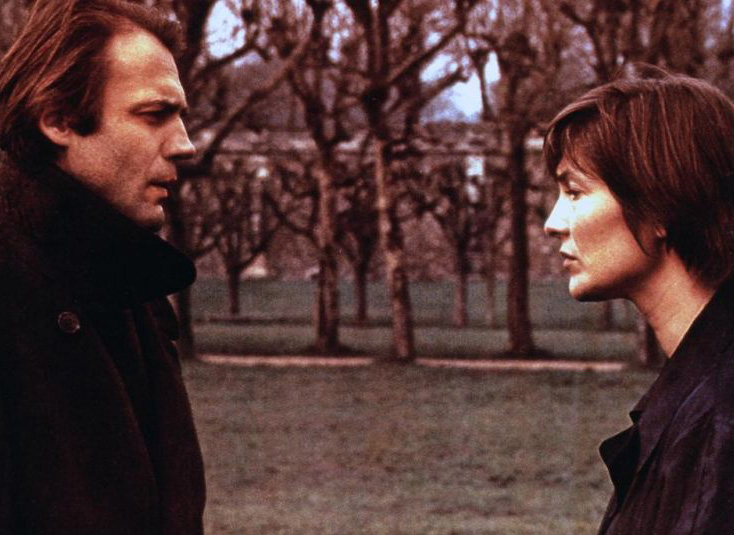
For his first feature, Handke leans heavily on two of his cinematic idols for inspiration, close collaborator Wim Wenders and Japanese filmmaker Yasujiro Ozu. From Wenders, he borrows regular actors Ganz and Rüdiger Vogler (in a charming cameo as himself), the longstanding cinematographer/ editor tandem of Robby Müller and Peter Przygodda, and the continental European milieu the two directors belonged to in the 1970's. Like the loners that populate Wenders' efforts of the period, Handke's protagonist is trapped between cultures, taken to bouts of silent introspection and wandering in search of some elusive place of belonging. Ozu, still a cult figure at the time, is lovingly referenced, twice overtly (Marianne sees his silent feature 'Tokyo Chorus' in a cinema, and a portrait of his face adorns her living room wall) and more subtly throughout the film (in the placid transitional shots, pervasiveness of trains, and the understated familial themes).
Homage aside, Handke proves himself a gifted visual storyteller with a painterly eye for tableaux, and a singular, almost rhythmic editing style. He bathes the still interiors and chilled, early-spring townscapes in golden sunlight and ponderous shadows, and utilizes clattering trains and brusque cuts like punctuation to underscore his heroine's ordeal. In its best stretches, the author turned filmmaker achieves a wordless beauty, refreshingly free of elucidation or psychology, that belies his literary calling.
Saturday, October 1, 2016
Review - Notes for a Film About Jazz (1965)

Wednesday, September 14, 2016
Review - The Cool World (1963)

Set amidst the unsavory street corners and Babylonian din of early 60's Harlem, Shirley Clarke's vivid, rough-edged drama tells the story of the Royal Pythons, a scrappy teen-aged gang trying to make a name for themselves. 15-year old Duke, a Python warlord (played with affecting stoicism by first-time actor Rony Clanton), aspires to become the club's president and have a reputation as a killer - for both he requires a gun. He arranges to buy a pearl-handled Colt from a local gangster, and spends the duration of the film frantically hustling to pay for it, violently clashing with a rival gang, ascending the ranks of his own crew, and reaping all that comes along with the top spot.
As she does in better known works like 'The Connection' and 'Portrait of Jason,' Clarke freely blends scripted narrative with elements of cinéma vérité. She forgoes set pieces for a series of authentic city locales, into which she disperses her players; bustling boulevards uptown, deserted playgrounds at dusk, a dreamily rendered Coney Island worthy of Morris Engel. The voyeuristic framework, exoticized setting, casting of non-actors and poor sound dubbing recall the ethnographic fictions of Jean Rouch, who's pioneering works shot in Africa are probably this film's closest antecedents. Like Rouch, Clarke presents a somewhat naive diagnosis of the community that she documents, in this case a relentless death-drive that compels the young African American protagonists to murder each other and pursue their own demise with little rationale. Fortunately for the filmmaker, the vitality and sheer energy of the inner-city neighborhood and its residents shine through.
While the simplistic superimposed storyline hangs a bit loosely from the dynamic imagery, the jazz score by the Dizzy Gillespie Quintet is tight and tensile, nimbly shadowing the onscreen action. The legendary trumpeter gets top billing, but it's Mal Waldron's kinetic compositions that constitute the film's greatest triumph. Waldron, who would go on to craft under-appreciated scores for 'Sweet Love, Bitter' and 'Three Rooms in Manhattan,' provides a masterful selection of moody themes and probing piano cues that complement the narrative in a number of inventive ways. On the boardwalk in Brooklyn, he incorporates a carnival organ that is playful yet ominous, and in one desperately needed scene of tenderness, a music box tinkles while Duke gives an impromptu geography lesson to LuAnne, a childlike teenage prostitute.
Sunday, September 4, 2016
Notes on... Muhammed Ali, The Greatest (1974)

Worthy of a fresh look but excluded from recent conversation is William Klein's 'Muhammed Ali, The Greatest.' Likely due to a confusing release history (its first section was put out as a standalone feature with a different title in 1969), as well as an emerging distaste among American audiences and critics for Klein's blatantly anti-U.S. stripe, his artful documentary was and is still rarely shown. It's a shame, as it is a sharply realized portrait of the complex fighter, one that is far more ingenious in conception than any of the aforementioned titles. The film boasts two rather bold formalistic innovations, the most striking of which is a bipartite narrative structure. Its first half, shot in 1964 in black and white, chronicles Ali's quest for the heavyweight championship, trailing him as he trains, whips up media frenzy and upsets the fearsome Sonny Liston twice. The young Ali, then still going by his birth name of Cassius Clay, is pompous yet introspective, confident of his greatness but increasingly aware of the glass ceiling he will inevitably crash into as a black athlete in the stifling racial climate of 60's America. Klein then jumps ahead to 1974 in full color, to the "Rumble in the Jungle" fight with Foreman, where a slightly ripened, but no less flamboyant or dominant Ali regains the title in another shocker.
The elision of the intervening decade - in which Clay joined the Nation of Islam, became Ali, refused to serve in Vietnam, and lost his public and professional stature - exemplifies the filmmaker's oblique storytelling slant. Rather than have one of his subjects speak his views on the state of racial affairs in 1964, Klein shows the stakes. He contrasts ghoulish, cigar-smoking stakeholders conferring about boxers as if they were livestock (distorted with the director's signature fish-eye lens) with stoic undercard fighters, grimly awaiting a grueling punishment that will likely be their moment in the sun. In Lewiston, Maine, the site of the second contest with Liston, the radicalization effect is not discussed but acted out by a group of black teenagers performing a psychodrama at the behest of a white teacher. It begins as a playful recreation of an pre-fight press conference (one student plays a cocky, shirtless Ali, another a journalist) and ends with spirited calls for black power and equality. Ten years later in Africa, the earthy, inspirational image of Ali is juxtaposed with the false magnanimity and authoritarian ubiquity of Zairean President Mobutu, who one cannot help but liken to the parasitic American fight promotors shown earlier. The strong insinuation is that no matter the color of their skin, a champion of the people will always run counter to the oppressor, and ultimately upstage him.
The most audacious of Klein's allusive tactics (and the second of the stylistic contrivances that distinguish his film) is the omission of any footage from the three featured fights. Usage was likely was not allowed due to copyright issues, but the director uses the restriction to his advantage, eschewing the ready-made climax of the title bout. He imaginatively fills in the gaps where the fight would have been shown, with iconic still photographs, flickering ringside montage that imitates flashbulbs but obscures the melee, even boastful, morning-after recollections from the fighter himself. More than a creative way of reframing the traditional sports documentary that demands action, Klein shifts focus to the profound depths of Muhammed Ali as a man, struggling against particularly difficult odds and times. The effect makes the viewer wonder if the film's title refers to Ali's pugilistic prowess, or something else altogether.
Subscribe to:
Posts (Atom)