
Showing posts with label German Cinema. Show all posts
Showing posts with label German Cinema. Show all posts
Monday, April 17, 2017
Review - The All-Around Reduced Personality aka Redupers (1978)

Wednesday, October 19, 2016
Review - The Left Handed Woman (1978)
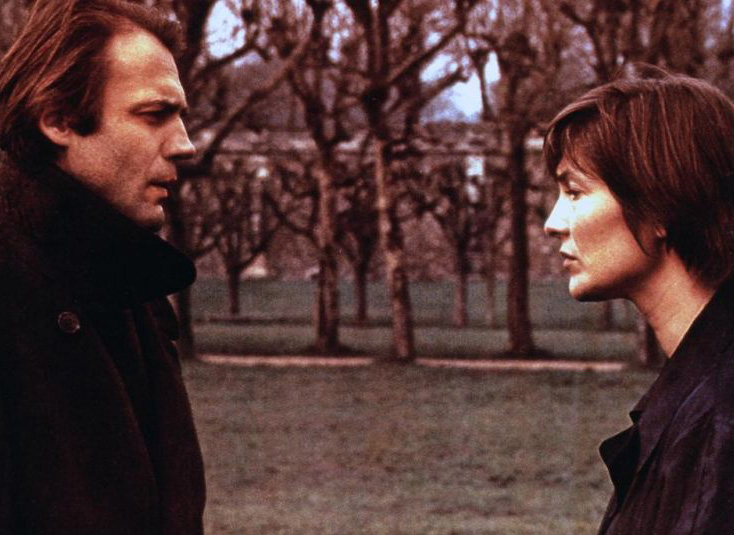
For his first feature, Handke leans heavily on two of his cinematic idols for inspiration, close collaborator Wim Wenders and Japanese filmmaker Yasujiro Ozu. From Wenders, he borrows regular actors Ganz and Rüdiger Vogler (in a charming cameo as himself), the longstanding cinematographer/ editor tandem of Robby Müller and Peter Przygodda, and the continental European milieu the two directors belonged to in the 1970's. Like the loners that populate Wenders' efforts of the period, Handke's protagonist is trapped between cultures, taken to bouts of silent introspection and wandering in search of some elusive place of belonging. Ozu, still a cult figure at the time, is lovingly referenced, twice overtly (Marianne sees his silent feature 'Tokyo Chorus' in a cinema, and a portrait of his face adorns her living room wall) and more subtly throughout the film (in the placid transitional shots, pervasiveness of trains, and the understated familial themes).
Homage aside, Handke proves himself a gifted visual storyteller with a painterly eye for tableaux, and a singular, almost rhythmic editing style. He bathes the still interiors and chilled, early-spring townscapes in golden sunlight and ponderous shadows, and utilizes clattering trains and brusque cuts like punctuation to underscore his heroine's ordeal. In its best stretches, the author turned filmmaker achieves a wordless beauty, refreshingly free of elucidation or psychology, that belies his literary calling.
Sunday, June 5, 2016
Notes on... The Short Films of Wim Wenders, 1967-1982

The earliest extant short from Wenders' film school
days in Munich, 'Same Player Shoots Again' is the sort of subversive formal
experiment that aspiring filmmakers at similar institutions lined up to make in
the 1960's. It's a deconstructionist take on a gangster film that plays very
loosely with genre tropes; seedy hotel rooms, phone booths, a tough bleeding in
the back seat of an American car, the central image of a wounded man trudging
along a street holding a rifle. This conventional imagery (the cinematic
language of B-movies) is divorced from familiar context and
scrambled in an attempt to disrupt the predictable ritual of filmgoing. The
looping of the gunman scene may confound and frustrate, but it also forces the viewer to think about what they're seeing, rather than settling in for another
gangster story. Something can certainly be inferred from the armed figure, who, with his long, military-style coat and assault rifle, evokes a Nazi solider as much as an archetypal criminal. By denying any exposition or context for this image, Wenders may implicitly offer a commentary
on the psyche of the young, post-war German cinéaste; while weaned on genre films, they had no interest in replicating formulae, and were even less interested in rehashing the national trauma. Subtly
hidden in ‘Same Player’ are two winking allusions to Jean-Luc Godard, who Wenders idolized (and "interviewed" for his 1982 short documentary 'Room 666'). The pinball theme (the main sequence is shown five
times and tinted a different color each time, a reference to the multicolored
balls allotted to a pinball player; also, the title) recalls the ever-present
arcade machines in 60’s Godard, particularly ‘Vivre Sa Vie.’ Another of the
French director's oft-utilized images accompanies the "Tilt' screen that functions as the end credit as well: the
Coca-Cola logo.


Visually and thematically, 'Alabama (2000 Light Years From Home)' picks up where 'Same Player' left off. It's another gangster story, this time containing a sequence of events that is fairly easy to follow: A trench-coated man enters a bar full of scruffy bohemians and accepts a mission to assassinate a figure that is never seen. He is shown driving to his destination, then back to the bar, apparently wounded. He slumps into the darkened establishment, where all of the patrons have been massacred, and puts a song on the jukebox. The camera then cuts back to the car as the man flees the city, fading to black before revealing his fate. What the short lacks in exposition, it makes up for with its unique use of music, which is playing in some form in every scene. The soundtrack (diegetic and non-diegetic) fills in the narrative gaps, providing emotional cues and even clues as to what's happening on screen. John Coltrane's ominous Alabama accompanies the street scenes where the man arrives at the bar, a portent of the events to come. Upon entering the first time, the lazy blues of The Wind Cries Mary by Jimi Hendrix plays, denoting an unsuspecting calm, while in the second scene, after everything has gone awry, the man selects another song by Hendrix on the jukebox, his raucous take of All Along the Watchtower. "There must be some kind of way outta here... the hour's getting late," he sings, the lyrics seeming to register with the man as he realizes that he must soon make his escape. Here, music is not a secondary consideration, subservient to the visuals or the story; it is equally as important as the other two components. In fact, it precipitates the images, evidenced by the film's title (a compound of song titles, of the Coltrane composition and another by The Rolling Stones). The importance of music to Wenders, as a creative catalyst, subject and cinematic tool, cannot be understated. He would go on to become a musical authority among directors, curating a number of noteworthy soundtracks, shooting several successful documentaries on musicians and setting some of his most memorable scenes around and during musical performances. 'Alabama' marks several firsts for the filmmaker. It was his first time working with cinematographer Robby Müller, who would lend his polished aesthetic and unique pallet to most of Wenders' films through the late 80's. Also, the clientele that loiters in the bar is the first significant look at contemporary Germans. They're just the sort of characters - misfits, hippies and artists - that weren't being depicted in national cinema before the advent of the New German Film, and that would populate the director's early 70's works (personified by actor Rüdiger Vogler). Lastly, the final shot is the first of many long takes from a moving car that Wenders would utilize throughout his career. A progression of the tableaux of 'Silver City,' he would expand upon the traveling shot in his next short, and it would later become a distinctive feature of his road movies.

'3 American LPs,' Wenders penultimate student exercise, is the director's first "filmed diary," as he would later refer to this sub-category of works that would include 'Reverse Angle' (covered below), 'Tokyo-Ga,' 'Notebook on Cities and Clothes' and (to an extent) 'Lightning Over Water.' Shot on grainy 16mm, it follows as he and an unseen companion (first time co-writer Peter Handke) drive from one unnamed German city to another, listening to songs and conversing about their love of American music as they go. The first segment takes place in a high-rise where one of the narrators peruses a record collection, a solemn redheaded woman smokes a cigarette on the terrace, and Van Morrison's 'Slim Slow Slider' plays. Next, Creedence Clearwater Revival's 'Lody' accompanies travel shots (taken from the car window) as the pair move from one city en route to another. Finally, after arriving at their destination, there is a final driving shot, a slow creep at dusk scored by Harvey Mandel's instrumental version of 'Wade In The Water.' Wenders is briefly glimpsed driving the car in the crepuscular light just before the credits appear. As simple as it seems, this film is loaded with hints as to where his career would go and how far it would range. It anticipates his diary films, which would all be narrated in the first-person, poetically shot (so as to avoid qualifying as pure documentary) and have an ostensible subject (though their true subject, as with a written diary, is inevitably the author). '3 American LPs' may also be considered his first road movie. Granted, he and Handke are not invented characters, but the central predicament is the same as in those narrative films: the reconciliation of one's actual surroundings (drab post-war Germany) with an idealized, almost fantastical place they wish to reach (America, the land of Hollywood and rock and roll). Lastly, this film represents the earliest union of Wenders' inseparable, twin obsessions, music and the open road, which would constitute a sort of dual philosophy for the director (introspection via art/outward searching), and characterize his entire body of work. Handke would go on to co-write Wenders' first feature, 1972's 'The Goalkeeper's Anxiety at the Penalty Kick' (his first traditional road-movie, adapted from Handke's novel), as well as 1975's 'Wrong Move' and the 1987 masterpiece 'Wings of Desire.' Wenders completed one more film while in Munich, his 1970 full-length thesis 'Summer in the City' (named after a song by The Lovin' Spoonful and dedicated to another American band, The Fugs). He would return very sparingly to the short film format in the years to come, doing so mostly for television.

Some thirteen years after '3 American LPs,' Wenders would pick up the thread of the diary film again with 'Reverse Angle: NYC March '82.' He shot it in New York while completing post-production for 'Hammett,' his disastrous Hollywood debut, which was finished, then allegedly taken over and reshot by producer Francis Ford Coppola. The frustrations experienced by the filmmaker, his estrangement as a European director working in America and many other impressions are documented in this intimate, free-form film. Wenders wanders the city, taking in the carnivalesque sites and musing philosophically, in a style that recalls the less-political works of Chris Marker, particularly 'Sans Soleil.' As he would in a proper journal, he arbitrarily rattles off his current interests: Edward Hopper's New York portraits, reading Emmanuel Bove's Mes Amis on the subway, the music of burgeoning no-wave band The Del-Byzanteens. It seems it's all he can do to ward himself from an increasingly volatile situation. Wenders would use the diary film quite effectively as a stopgap between features in the 1980's, either as a diversion during a difficult period ('Reverse Angle') or while he made preparations to mount a large production ('Notebook on Cities and Clothes,' shot while orchestrating 'Until the End of the World'). In the 1990's, he transitioned to making smaller features and more traditional documentaries, a balance he maintains to this day. Though 'Reverse Angle' appears to have little in common with the student projects in the late 60's, when viewed alongside those shorts, it further illustrates the director's clearly defined themes and singular narrative voice.
Tuesday, May 17, 2016
Notes on... History Lessons (1972)

If the notoriously bewildering filmmaking tandem of
Jean-Marie Straub and Danièle Huillet had a patron saint, it would undoubtedly
be Bertolt Brecht. Like the pair, the German playwright's career was informed
by staunch Marxist beliefs and a devotion to the avant-garde as a means for
social change. He also introduced to the dramatic vernacular the
"estrangement effect," a term so befitting the filmmaking style of
Straub-Huillet that it could title a monograph on their collected works.
According to this principle, rather than striving for an empathetic
viewer-subject relationship, dramatists should actively work to subvert
narrative norms that lull audiences into complacency. To increase the
likeliness that they will intelligently consider what they're witnessing,
viewers must routinely be shocked, jostled, and knocked off balance. This
concept can be said to underpin all of the Straub-Huillet films, most of all 'History Lessons,' their adaptation of Brecht's only novel, The Business Affairs of Mr. Julius Caesar.
Like an even sparer reduction of Rosselini's 'Socrates,' this unconventional
biopic recounts the life of the founder of the Roman Empire through long
scenes of unembellished dialogue. In a series of blatantly staged tableaux, an
unnamed man in modern dress interviews costumed historical figures who knew or
encountered Caesar. Photographed rigidly against bucolic backdrops, the blank
faced actors pose like mannequins and recite their dialogue in harsh-sounding
German. As if the staginess of these scenes wasn't perplexing enough, they're
intercut with long, static, in-car shots of the modern interlocutor driving
around present-day Rome, seemingly without destination or urgency. Viewers
familiar with Brecht's epic theatre (or the Straub-Hulliet oeuvre) may know
what to make of it all, but most will be left scratching their heads, or worse,
nodding off from the lack of action. Indeed, estrangement is in full effect.
Still, through these awkward retellings of key episodes, the
filmmakers do succeed in conceiving of a more concrete, modern Julius Caesar.
Neither magisterial statesman nor imposing military commander, their version is
something much more novel, a proto-capitalist in an imperial age. He did not
enslave and execute out of ruthlessness, but to gain economic advantage, and
through instinct and opportunism built the most powerful empire of his day. The
anachronistic modern figure on his trail functions as a link to our
present-day world. When juxtaposed with the dialogue scenes, his excursions
through the streets of Rome are imbued with a fresh significance: choked with
cars, commerce and milling crowds, the city is transformed into a monument to
Caesar's machinations. Such are the suggestive powers of Straub and Hulliet.
Much more than a demythologization (or didactic exercise as the title
suggests), this unorthodox work compels us to consider what really spurs a man
to seize power, and strongly implies that the world we inhabit today is still
shaped by men of that ilk. By not showing the audience what it expects to see,
they evoke the very notion they wish to impart, and without a single
ideological statement, they politicize the viewer. It's more than a neat trick;
it's the result of a finely tuned method that the pair, like seasoned
dramaturges, employed year after year, film after film.
Saturday, May 14, 2016
Notes on... Not Reconciled (1965)

Based on a 1959 novel by Heinrich Böll, 'Not Reconciled' tells the fragmented tale of the Faehmel family, focusing on three generations and how they took part in and were effected by the events of the Second World War. Heinrich Faehmel, accomplished pre-war architect is the father of Robert and grandfather of Joseph, both trained in architecture as well. Through flashbacks, we see how Robert falls in with a group of war-dissenters, is exiled from Germany, then conscripted into the Nazi ranks and tasked with demolishing buildings, including an abbey designed by his father. On Heinrich's 80th birthday, there's a reconciliation, an unexpected act of violence perpetrated by the family matriarch, and a glimmer of hope in the form of Joseph, who it seems will elude the guilt and trauma of the Third Reich. The intricate, intergenerational narrative moves freely and quickly between past and present, creating a disorienting, dreamlike tone that is no accident. Just as Arthur Penn adapted dynamic New Wave editing and sequencing to bring a sense of existentialist paranoia to 'Mickey One' the same year, Straub-Huillet use these methods to engender a feeling of moral confusion and inconsequence. Like a nightmare shared by an entire nation, the ethical morass of World War 2 and the ensuing ambivalence is a dream state that the fated characters have fallen into.
A few seconds into the film, while shooting billiards, Robert essentially asks the audience "what would you like to know?" As the camera pans down to the spiraling balls, we're zipped to a sports field where young boys are playing, one of them a school-aged Robert whose story we are about to witness. It's straightforward enough in this instance, but this sort of leap through time without warning or elucidation happens throughout 'Not Reconciled.' Related to, but practically distinct from the jump-cut (which skipped the formalities, so to speak, by cutting out old-fashioned transitions), these warp-cuts accomplish quite a bit more. They help to create a discombobulated feel that mirrors the moral disarray of the characters. As they are mostly jumps in time, they also obscure the lines between past and present, highlighting the interconnectedness of generations and allowing for the reexamination and re-contextualization of past transgressions. The disjointed narrative itself is a hallmark of the New Wave, specifically the works of Alain Resnais. Straub-Huillet also populate their film with inexpressive actors, not to capture some truthful essence or prosaic charm as with Godard's non-actors, but to characterize the ambiguous nature of the Faehmel family, and by extension, post-war Germany.
Earlier this year, the Museum of Modern Art (who screened this film as part of their complete Straub-Huillet retrospective) hosted an enlightening series called Germany 66 that focused on the watershed year in which the New German Cinema took form. What surprises me most about Straub and Huilliet's debut is not its stylishness or lively pacing when compared to their later works, but how neatly it would have fit into the slate at MoMA beside first features from Volker Schlöndorff and Alexander Kluge. Right alongside the new class of native filmmakers (and ahead of quite a few of them), the French duo diagnosed the national ills of their adopted country, and the results are revelatory. Like the finest entries in the Young German Film, they grappled with the demons of the Nazi horror, incorporated the richness of German literature, and helped mend the seemingly irreparable rift in the nation's cinematic lineage. That Straub-Huillet found their way to the vanguard of this movement should not come as a surprise. The itinerant filmmakers came to these insights as they always did, through their profound understanding of the arts, and what those arts communicate about their creators.
Subscribe to:
Posts (Atom)